
Content factory: turn one podcast into twenty assets
A repeatable workflow that takes a single 45-minute conversation and ships a month of platform-native content — without losing the brand voice.
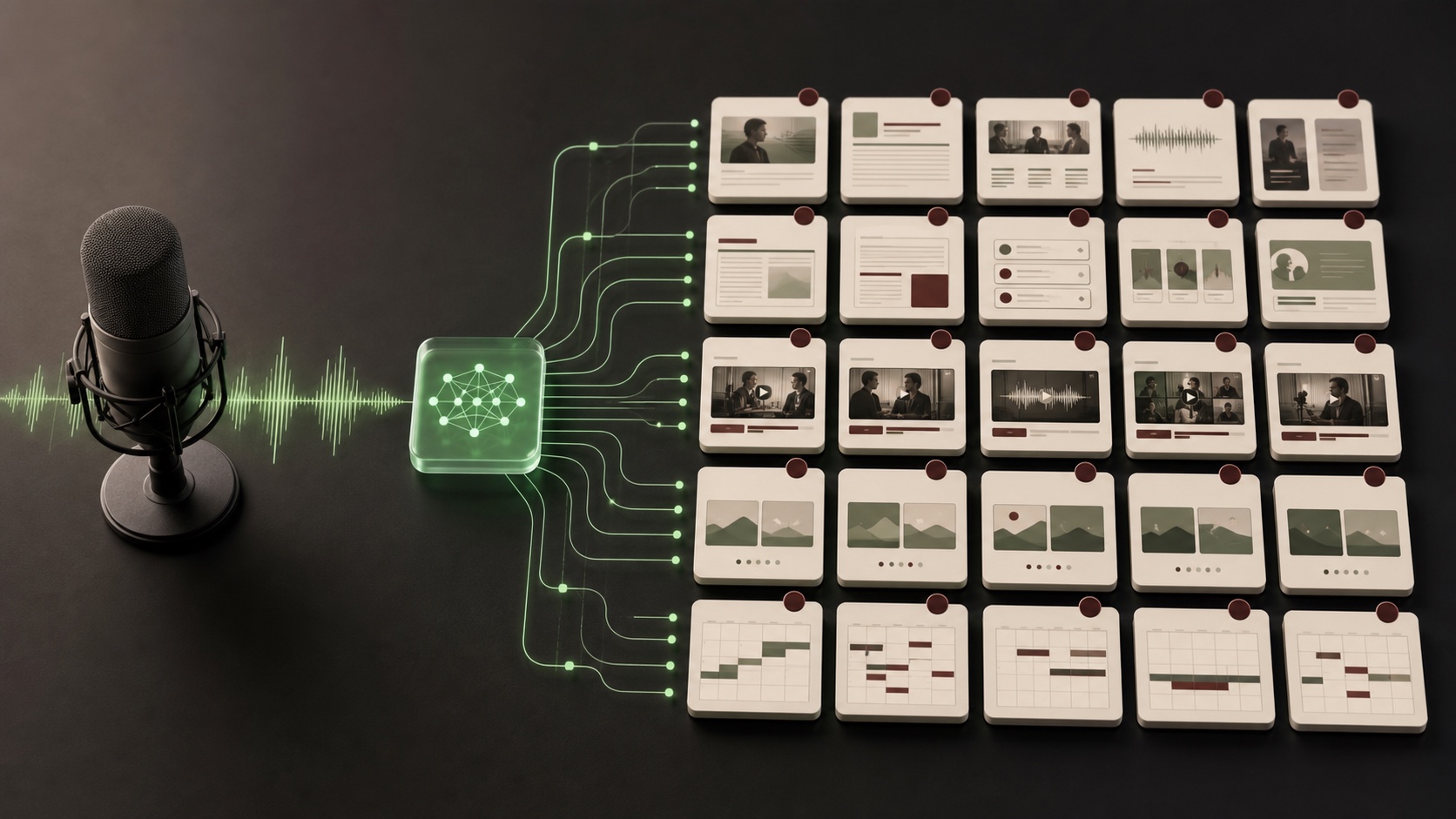
The dirty secret of content marketing is that everyone is exhausted. You ship a great podcast episode and then you're supposed to write three blog posts, six LinkedIn threads, eight tweets, a newsletter, and four short-form video cuts from it — and still have time for the next episode.
The teams who keep this rhythm aren't more disciplined than yours. They've built a content factory.
Here's the workflow we ship to clients.
The raw asset
You record one 45–60 minute long-form piece per week. A podcast, a fireside, a webinar, a sales-call recording. The format is asynchronous — you talk into a microphone, you ship.
This is the only source asset. Everything else is downstream.
The pipeline
The pipeline runs automatically in the background each time a new source is uploaded:
- Transcribe — Whisper or Deepgram, speaker-diarized, time-stamped.
- Brand-voice extraction — an LLM pass that pulls the recurring phrases, opinions, and turns of phrase from your past content, and applies them to the new output.
- Topic chunking — the transcript is broken into 6–10 self-contained topics. Each one becomes a candidate asset.
- Asset generation — for each topic, drafts are generated in parallel:
- 1 long blog post (1,200–1,800 words)
- 1 newsletter section
- 3 LinkedIn posts (different angles)
- 3 Twitter/X threads
- 2 short-form video scripts (15s and 60s)
- 1 image carousel outline
- Human review — every asset hits a single approval inbox. Your editor approves, edits, or rejects in a few clicks.
- Schedule and publish — approved assets push to Buffer, Notion, Substack, and your CMS via webhook.
End to end, one human reviewer can run an entire content team's worth of output in 90 minutes a week.
Why it doesn't sound like AI slop
Two reasons:
- Voice extraction is the secret. We don't ask the model to "write like a marketing pro." We give it 30 of your past pieces and ask it to imitate you. The result reads like the same person who recorded the podcast, because in a deep sense, it is.
- The source is real. You're not asking AI to invent ideas. You're asking it to repackage ideas that you already said out loud, with conviction, in your own voice.
The model is an editor, not an author. That distinction is everything.
What this unlocks
Clients running this pipeline typically see:
- 5–10× asset output from the same source effort
- Consistent presence across 4–6 platforms instead of one
- A measurable lift in inbound (most see 25–40% more qualified leads within a quarter)
- Their team finally getting weekends back
Want to see this run against one of your existing recordings? Send us a link and we'll process the first one as a demo. Get in touch →